25/09/2026


Share
Core Elements Behind the Quality of Hirota Precision Vietnam’s Stamping Dies
Information
Share
Table of Contents
When partnering with Hirota Precision Vietnam, many clients often ask: “What ensures the absolute durability and precision of Hirota’s stamping dies across millions of operational cycles?”
The answer lies not in a single factor, but rather in a deliberate combination of an all-in-one production model, precise material selection, state-of-the-art equipment, and strict Japanese quality management standards.
The “All-in-One” Closed-Loop Model: From Concept Blueprint to Finished Product
In Vietnam, most supporting industry enterprises handle only a single stage: either specialized in designing/building dies before handing them over to clients for stamping, or performing contract stamping using pre-existing dies.
The capability to both manufacture dies in-house and directly stamp finished products under one roof is a standout competitive advantage of Hirota Precision Vietnam.
This closed-loop model delivers three practical benefits to businesses:
- Technical Optimization: Completely eliminates the risk of tolerance discrepancies between the die blueprint and actual stamping operations.
- Immediate Troubleshooting: The engineering team performs die maintenance directly at the workshop whenever issues arise, preventing any disruption to the client’s production line.
- Shorter Timelines: Clients work with a single point of contact, accelerating the journey from prototyping to mass production.
Die Materials: Matching the Right Steel Grade to the Right Application
A progressive stamping die withstands continuous impact forces over hundreds of thousands to millions of cycles.
To ensure die longevity while optimizing costs for clients, Hirota allocates four specialized steel grades according to their specific functions:
- SS400: General structural steel, easy to machine and cost-effective. Primarily used for die bases and frames—areas requiring structural rigidity rather than surface wear resistance.
- S50C: Medium carbon steel capable of heat treatment. Suitable for mechanical load-bearing components such as guide pins and support plates.
- SKD11: High-chromium cold-work alloy steel offering exceptional wear resistance and minimal distortion during heat treatment. This is the primary choice for punches, dies, and cutting edges in progressive stamping dies.
- SKH51 (High-Speed Steel): Offers superior hardness and heat resistance compared to SKD11. Prioritized for high-wear cutting applications or when stamping hard, thick metal strips.
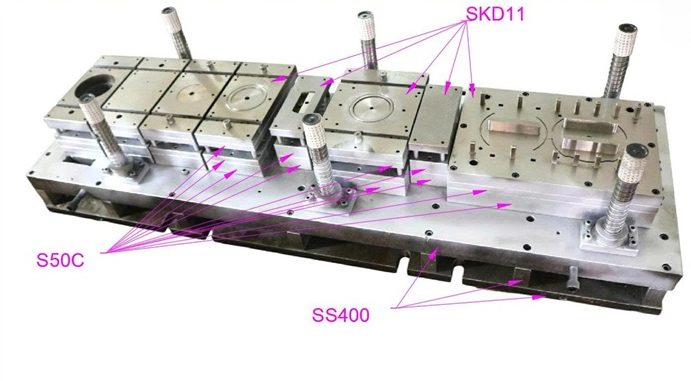
Steel Grade Allocation Across Progressive Die Components
Core Stamping Technologies: Progressive Stamping & Deep Drawing
Hirota Precision Vietnam specializes in two core sheet metal processing technologies tailored to meet the demanding requirements of the electronics, automotive, and motorcycle industries:
- Progressive Stamping: Metal strips travel sequentially through multiple successive stations (piercing, bending, cutting, etc.). This method achieves high production rates, precise repeatability, and cost-efficiency for high-volume orders.
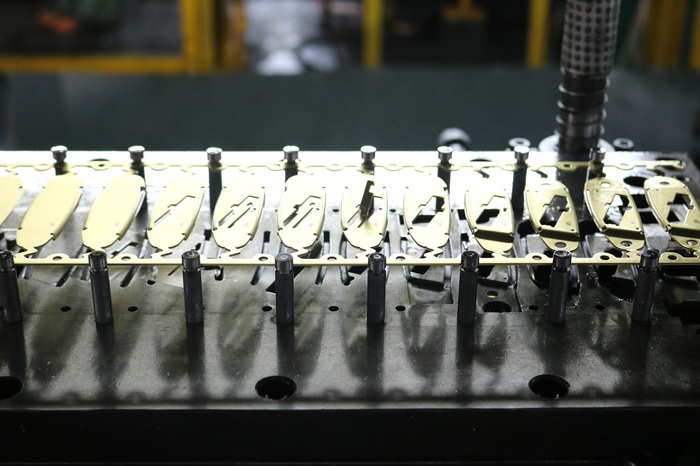
The metal strip advances through multiple successive stations.
- Deep Drawing: Sheet metal is stretched into a die cavity to form components with depth, such as enclosures, caps, or cup-like parts. This technology requires strict control over pressing force, stamping speed, and lubrication to prevent material tearing or wrinkling.
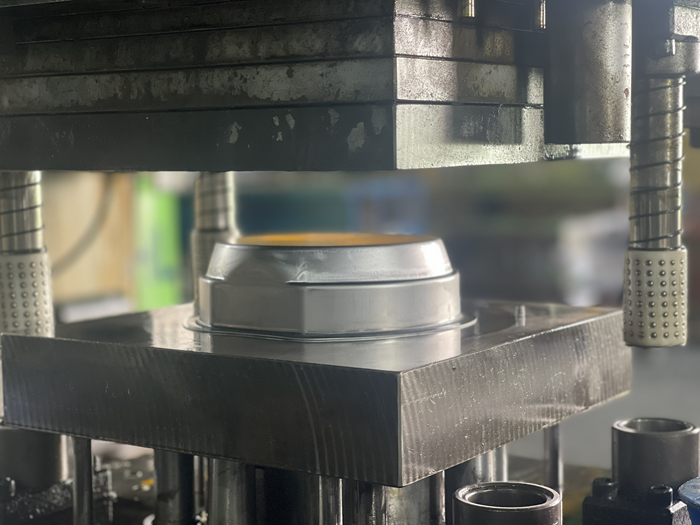
Deep drawing process for motor end caps
Advanced Equipment & Micron-Level Precision Measurement
The quality of Hirota’s tooling is guaranteed by a synchronized fleet of processing and inspection machinery:
- Stamping Presses Up to 500 Tons: Capable of stamping thick and large-scale metal parts while ensuring die load safety.
- Wire EDM Machines: Precision machining of complex profiles on hardened steel with micron-level tolerances.
- 3D CMM (Coordinate Measuring Machine): Inspects and cross-checks actual dimensions against CAD drawings, ensuring 100% quality control prior to delivery.
IATF 16949 International Standard & Sustainable Trivalent Chromium (Cr3+) Plating
To satisfy the rigorous requirements of global automotive and electronics supply chains, Hirota Precision Vietnam implements international compliance solutions:
- IATF 16949 Quality Management System: Ensures that all processes—from design and raw material control to manufacturing—strictly comply with automotive industry standards.
- Trivalent Chromium (Cr3+) Zinc Plating Technology: The Cr3+ coating delivers superior corrosion resistance and satisfies RoHS compliance for export to demanding markets such as Europe, Japan, and the US.
The Human Element: Japanese Expertise & Proactive Maintenance
Advanced equipment is a prerequisite, but people are the decisive factor in die quality. At Hirota Precision Vietnam:
- Japanese Technical Experts: Japanese engineers directly advise on and supervise complex die design stages while resolving challenging tolerance issues.
- Proactive Preventative Maintenance: Regularly performed on-site at the workshop, preventative maintenance detects early die wear for timely intervention, ensuring the tooling operates in peak condition.
Closing Remarks
From an all-in-one closed-loop model, optimized steel grade allocation, and synchronized equipment infrastructure to IATF 16949 certification—Hirota Precision Vietnam delivers more than just stamping dies and sheet metal parts.
We provide comprehensive, Japanese-standard engineering solutions that empower our clients’ sustainable growth and competitive edge.
Share
News and Columns
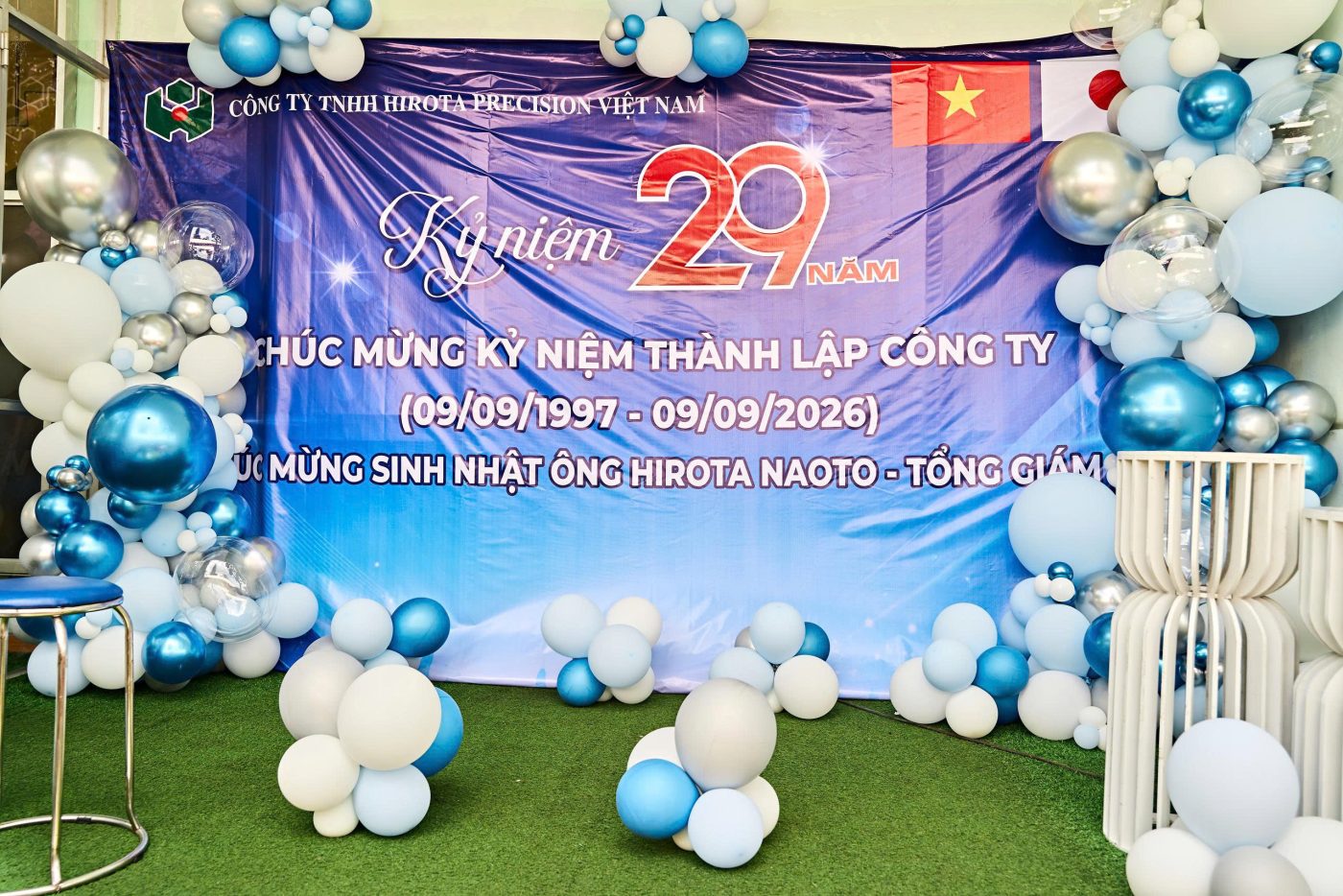
29 YEARS OF ONE JOURNEY – SEPTEMBER 09, 2026
Information
29 YEARS OF ONE JOURNEY – SEPTEMBER 09, 2026
22/09/2026

A JOURNEY OF UNITY – COMPANY TRIP TO NHA TRANG 2026
Information
A JOURNEY OF UNITY – COMPANY TRIP TO NHA TRANG 2026
14/08/2026

Taking on the Aerospace Industry: Three-Day Training Toward AS9100D Certification
Information
Taking on the Aerospace Industry: Three-Day Training Toward AS9100D Certification
14/07/2026